
Comprehensive Industrial Connectivity Market Report Covers Forecasts, Innovations And Industry Outlook
The Business Research Company’s Industrial Connectivity Global Market Report 2026 – Market Size, Trends, And Forecast
Press Release Disclaimer: This is a press release distributed through the XPR Media network. It has not been independently verified by our newsroom.

The Business Research Company’s Industrial Connectivity Global Market Report 2026 – Market Size, Trends, And Forecast 2026-2035
LONDON, GREATER LONDON, UNITED KINGDOM, October 27, 2026 /EINPresswire.com/ — “The industrial connectivity market is on the cusp of transformation, driven by the integration of unified IoT connectivity solutions that link industrial devices seamlessly across terrestrial and satellite networks. This shift is highlighted by strategic collaborations such as the partnership in October 2025 between Semtech Corporation and Skylo Technologies, Inc., underscoring the growing emphasis on real-time data exchange, cybersecurity, and interoperability in the industrial sector.
Projected Expansion and Size of the Industrial Connectivity Market
By 2030, the industrial connectivity market is anticipated to surpass $75 billion in value. Within the wider Information Technology sector, which is expected to reach $13,788 billion by the same year, this market segment will represent close to 0.5% of the total industry worth. The market is forecasted to grow steadily at a compound annual growth rate (CAGR) of 6% through 2030, reflecting robust demand across multiple industries.
Request A Free Sample Of The Industrial Connectivity Market Report
https://thebusinessresearchcompany.com/sample_request?id=63941467&type=smp&name=Industrial%20Connectivity%20Market%20Report%202026&utm_source=EINPresswire&utm_medium=Paid&utm_campaign=Oct_PR
North America’s Leading Role in Industrial Ethernet and Private Wireless Growth
North America is set to dominate the industrial connectivity market with a valuation of $25 billion in 2030, up from $20 billion in 2025, growing at a CAGR of 5%. This growth is primarily driven by broad adoption of industrial Ethernet and private wireless networks, modernization efforts in manufacturing and processing sectors, and expanding connected factory initiatives. Additionally, investments targeting energy, utilities, and transportation infrastructure alongside increasing needs for real-time data exchange and interoperability support this upward trend across the United States and Canada.
The United States as the Largest Single Market
Within North America, the United States is expected to hold the largest share, reaching $22 billion in the industrial connectivity market by 2030 from $18 billion in 2025, also at a 5% CAGR. Growth here is propelled by the rise of smart, connected production facilities, ongoing upgrades of network infrastructure, growing edge computing adoption, and increased automation in automotive, aerospace, and semiconductor manufacturing sectors. The demand for resilient, low-latency communication networks alongside continuous factory modernization also bolsters this expansion.
Access The Detailed Industrial Connectivity Market Report Here
https://thebusinessresearchcompany.com/report/industrial-connectivity-market-report?utm_source=EINPresswire&utm_medium=Paid&utm_campaign=Oct_PR
Hardware Dominates Industrial Connectivity Revenue
Breaking down the market by component, hardware is forecasted to be the largest contributor, making up 49% or about $36 billion of the industrial connectivity market in 2030. The sector’s growth is supported by the deployment of industrial switches, routers, gateways, and communication modules, as well as the replacement of older equipment with faster, more ruggedized devices suited for harsh industrial environments. Additionally, investments in machine-to-machine communication and connected production assets drive the demand for reliable, high-performance networking hardware.
Segmentation Highlights in Industrial Connectivity
The industrial connectivity market can be segmented in several ways: by technology (including industrial Ethernet, fieldbus communication, cellular connectivity, low power wide area networks, and industrial wireless LAN); by network type (wired and wireless); by deployment model (on-premise and cloud-based); and by end-use sectors such as aerospace and defense, automotive, chemical production, energy and utilities, food and beverage, healthcare, manufacturing, mining and metal, oil and gas, transportation, and others. These layers of segmentation illustrate the diverse applications and technology preferences shaping the market.
Automation and IIoT Accelerate Industrial Connectivity Growth
The industrial connectivity market’s rapid expansion through 2030 is fueled by three main factors. First, the increasing adoption of industrial automation and smart manufacturing boosts productivity and lowers operational costs by linking machines, robots, sensors, and control systems for real-time monitoring and predictive maintenance. Industry 4.0 initiatives in manufacturing, energy, automotive, and logistics sectors further drive demand for robust connectivity, contributing an estimated 1.5% annual growth to the market.
Next, the widespread deployment of Industrial Internet of Things (IIoT) devices, including connected sensors, smart meters, and monitoring equipment, allows facilities to collect and analyze operational data in real time. This connectivity enhances asset visibility and operational efficiency while reducing downtime and maintenance expenses, adding approximately 1.3% annual growth. Additionally, increasing demand for real-time data monitoring and predictive maintenance supports continuous machine oversight, enabling early failure detection and minimizing unplanned downtime, which contributes roughly 0.9% growth each year.
Innovations Reinventing Industrial Connectivity
Unified IoT connectivity solutions are reshaping the industrial connectivity landscape by ensuring uninterrupted communication across both terrestrial and satellite networks. A notable example is the October 2025 collaboration between Semtech Corporation and Skylo Technologies, Inc., which introduced a device-to-cloud cellular and satellite IoT connectivity solution. This platform features automatic network switching, centralized device management, and monitoring capabilities that enhance connection reliability, operational efficiency, and the speed of industrial data transmission.
Cisco Systems Leads the Market with Industrial Networking Products
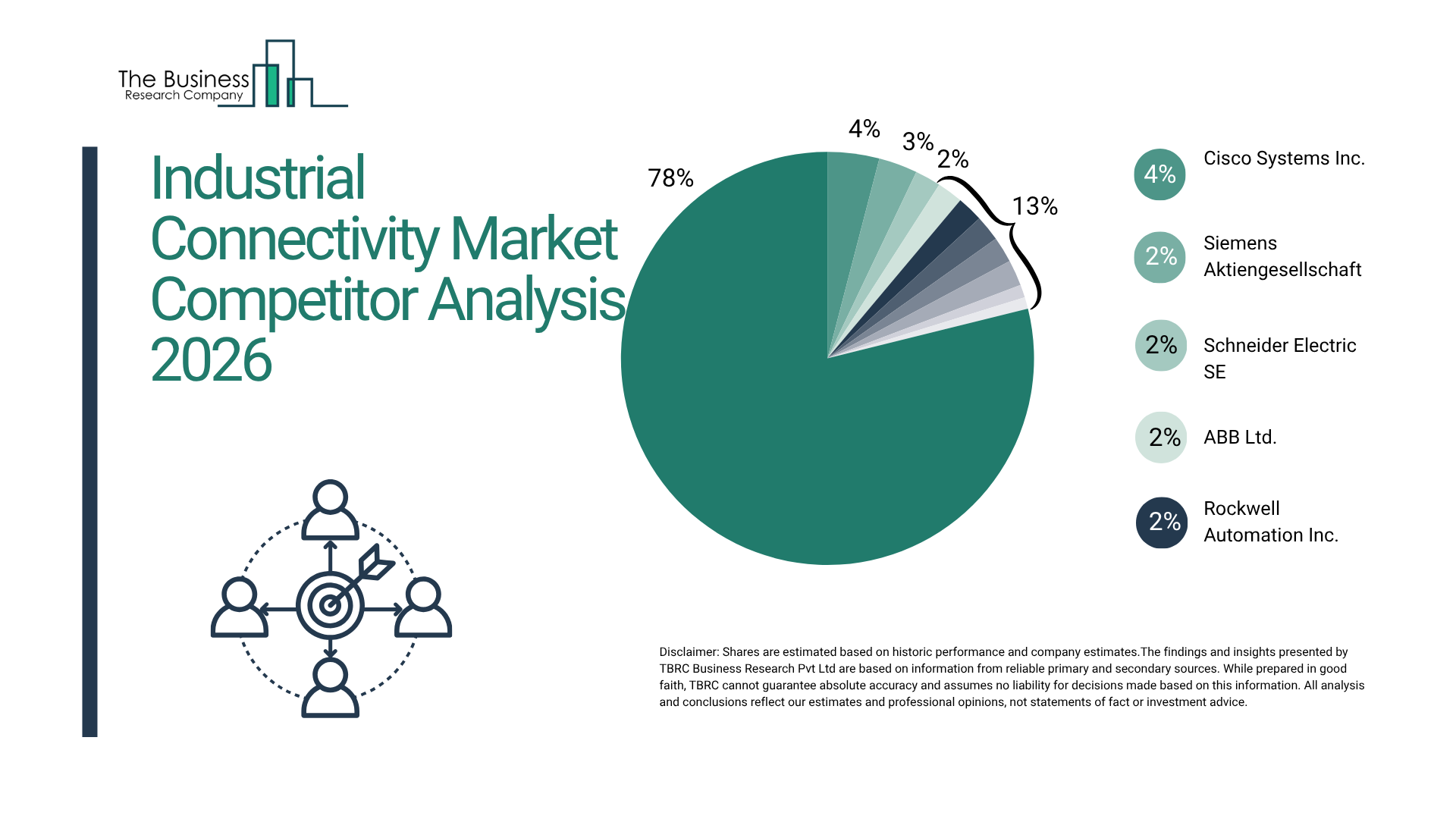
In 2025, Cisco Systems Inc. held the largest share of the global industrial connectivity market at 4%, according to The Business Research Company. Cisco’s industrial networking division provides a broad range of products including industrial Ethernet switches, routers, wireless connectivity solutions, edge networking systems, and secure communication platforms designed to support smart manufacturing, industrial automation, IIoT, and critical infrastructure.
Major Competitors in the Industrial Connectivity Industry
Key players in the industrial connectivity market feature a mix of global technology giants and specialized firms such as Cisco Systems Inc., Siemens Aktiengesellschaft, Schneider Electric SE, ABB Ltd., Rockwell Automation Inc., Honeywell International Inc., Microsoft Corporation, IBM, Intel Corporation, Alphabet Inc. (Google LLC), Telefonica SA, Qualcomm Technologies Inc., Verizon Business Network Services Inc., Orange SA, Belden Inc., PTC Inc., Digi International Inc., Advantech Co Ltd., Moxa Inc., and Inductive Automation LLC.
Market Fragmentation and Competitive Dynamics
The industrial connectivity market is moderately fragmented, with the top ten vendors responsible for 22% of total revenue in 2025. Barriers to entry include complex industrial networking requirements, stringent cybersecurity demands, the need for interoperability across diverse systems, and the necessity for highly reliable, low-latency communication. Leading companies maintain their positions through diverse connectivity product portfolios, partnerships across manufacturing and automation sectors, global service networks, and ongoing innovation in areas such as edge computing and IIoT. As demand for secure, interoperable industrial communication rises, strategic collaborations, platform integration, and product development will likely intensify competition and solidify market positions.
Competitive Strategies Shaping Industry Growth
Industry leaders are focusing on advancing connectivity technologies to enable real-time monitoring and control, adopting sophisticated network architectures to improve interoperability and system visibility, expanding IIoT and edge infrastructure to boost scalability and reliability, and integrating AI-driven network automation to enhance fault detection and resilience within industrial networks.
Hardware’s Significant Contribution to Market Growth
Together, hardware, software, and services segments are expected to add over $19 billion to the industrial connectivity market’s value between 2025 and 2030. Hardware alone is forecasted to grow by $7 billion during this period, driven by technologies such as Time-Sensitive Networking (TSN) and deterministic communication, which facilitate convergence between operational technology (OT) and information technology (IT). This growth is also supported by the adoption of industrial communication protocols aimed at interoperability, investments in predictive maintenance, remote asset connectivity, and the rising need for scalable connectivity to support autonomous operations—factors reflecting the industry’s shift toward intelligent factories and resilient communications.
Suppliers, Distributors, and End Users in the Industrial Connectivity Market
The industrial connectivity supply chain includes large raw material providers such as Siemens AG, Schneider Electric SE, ABB Ltd., Rockwell Automation Inc., Emerson Electric Co., Honeywell International Inc., Mitsubishi Electric Corporation, Yokogawa Electric Corporation, Omron Corporation, Bosch Rexroth AG, General Electric Company, Cisco Systems Inc., Intel Corporation, Texas Instruments Incorporated, Analog Devices Inc., STMicroelectronics N.V., NXP Semiconductors N.V., Infineon Technologies AG, Qualcomm Incorporated, Broadcom Inc., Hilscher Gesellschaft für Systemautomation mbH, Belden Inc., Phoenix Contact GmbH & Co. KG, and Advantech Co. Ltd.
Major wholesalers and distributors facilitating market reach include Ingram Micro Inc., Arrow Electronics Inc., Avnet Inc., Digi-Key Electronics, Mouser Electronics Inc., Future Electronics Inc., RS Components Limited, TTI Inc., Allied Electronics and Automation LLC, Sager Electronics Inc., Macnica Inc., Westcon Group Inc., Exclusive Networks SA, ALSO Holding AG, Esprinet S.p.A., ScanSource Inc., Redington Limited, Tech Data Corporation, Synnex Corporation, D&H Distributing Company, EET Group A/S, Bechtle AG, Cancom SE, Mindware FZ LLC, and Logicom Public Limited.
Among the key end users are companies such as BMW Group, Volkswagen AG, Mercedes-Benz Group AG, Toyota Motor Corporation, General Motors Company, Ford Motor Company, Bosch Manufacturing Systems, Coca-Cola Company Manufacturing Operations, Nestlé S.A. Industrial Operations, Samsung Electronics Manufacturing Division, Foxconn Technology Group, Shell plc Industrial Division, ExxonMobil Chemical Operations, ArcelorMittal Industrial Facilities, BASF SE Production Plants, Huawei Technologies Industrial Solutions, Tata Steel Limited Operations, Reliance Industries Manufacturing Division, GE Aerospace Industrial Systems, and Amazon Robotics Operations.
Our 2026 reports feature deeper market intelligence with market attractiveness scoring and analysis, total addressable market (TAM) analysis, company scoring matrix graphics and tables, Excel-based forecasting dashboards, market hotspots infographics, key technologies and future trend analysis, and updated graphics and tables.
Learn More About The Business Research Company
The Business Research Company (www.thebusinessresearchcompany.com) is a leading market intelligence firm renowned for its expertise in company, market, and consumer research. We have published over 30,000+ reports across 27 industries and 60+ geographies. Our research is powered by 1,500,000 datasets, extensive secondary research, and exclusive insights from interviews with industry leaders.
We provide continuous and custom research services, offering a range of specialized packages tailored to your needs, including Market Entry Research Package, Competitor Tracking Package, Supplier & Distributor Package and much more.
Disclaimer: Please note that the findings, conclusions and recommendations that TBRC Business Research Pvt Ltd delivers are based on information gathered in good faith from both primary and secondary sources, whose accuracy we are not always in a position to guarantee. As such TBRC Business Research Pvt Ltd can accept no liability whatever for actions taken based on any information that may subsequently prove to be incorrect. Analysis and findings included in TBRC reports and presentations are our estimates, opinions and are not intended as statements of fact or investment guidance.
Contact Us:
The Business Research Company
Americas +1 310-496-7795
Europe +44 7882 955267
Asia & Others +44 7882 955267 & +91 8897263534
Email: marketing@tbrc.info
Follow Us On:
LinkedIn: https://in.linkedin.com/company/the-business-research-company“
Oliver Guirdham
The Business Research Company
+44 7882 955267
info@tbrc.info
Visit us on social media:
LinkedIn
Facebook
X
Legal Disclaimer:
EIN Presswire provides this news content “as is” without warranty of any kind. We do not accept any responsibility or liability
for the accuracy, content, images, videos, licenses, completeness, legality, or reliability of the information contained in this
article. If you have any complaints or copyright issues related to this article, kindly contact the author above.

Media gallery
